The Verdict
ClawPane — you've got a genuinely clever AI routing product, clean copy, and transparent pricing. The bones of this dish are EXCELLENT. But you've served it on a dirty plate with no garnish. ZERO testimonials, ZERO customer logos, and a 7-second mobile load time that's actively burying your SEO rankings while you sit there twiddling your thumbs. You're asking developers to hand over their API keys based on... what, exactly? A nice font? Fix the trust, fix the mobile disaster, and you've got something that actually converts.
Sharp Product, ZERO Social Proof, and a Mobile Load Time That Could Age Cheese
Right. Let's talk about ClawPane. The concept is sharp — a smart routing layer for OpenClaw that genuinely saves money, and you've had the sense to say so clearly. 'Cut model spend. Keep quality.' — BOOM. That's a headline. The pricing is transparent, the docs are useful, and you're not trying to be everything to everyone. Rare. Admirable. I'm almost impressed. BUT — and this is a massive, flaming, Gordon-Ramsay-sized BUT — this site is a Michelin-quality kitchen with no reviews, no photos of the food, and a front door that takes SEVEN SECONDS to open on mobile. You've built a product for cost-conscious, trust-driven developers and then given them absolutely NOTHING to trust. No testimonials. No customer logos. No 'Company X slashed their LLM bill by 38%.' NOTHING. You're asking people to route their production AI traffic through your servers based on... vibes and a GitHub link? That's not a conversion strategy, mate. That's a PRAYER. And the irony — oh, the beautiful, painful irony — is that your AI infrastructure product is completely invisible to AI-powered search engines. No llms.txt. No explicit bot permissions. You build smart routing for AI, and AI can't even find you. That's like a fire station burning down. Fix the trust layer. Fix mobile performance. Add the llms.txt. Three focused afternoons. Do it.
Hero Section
DECENT
Right, your hero. Let's dissect this plate.
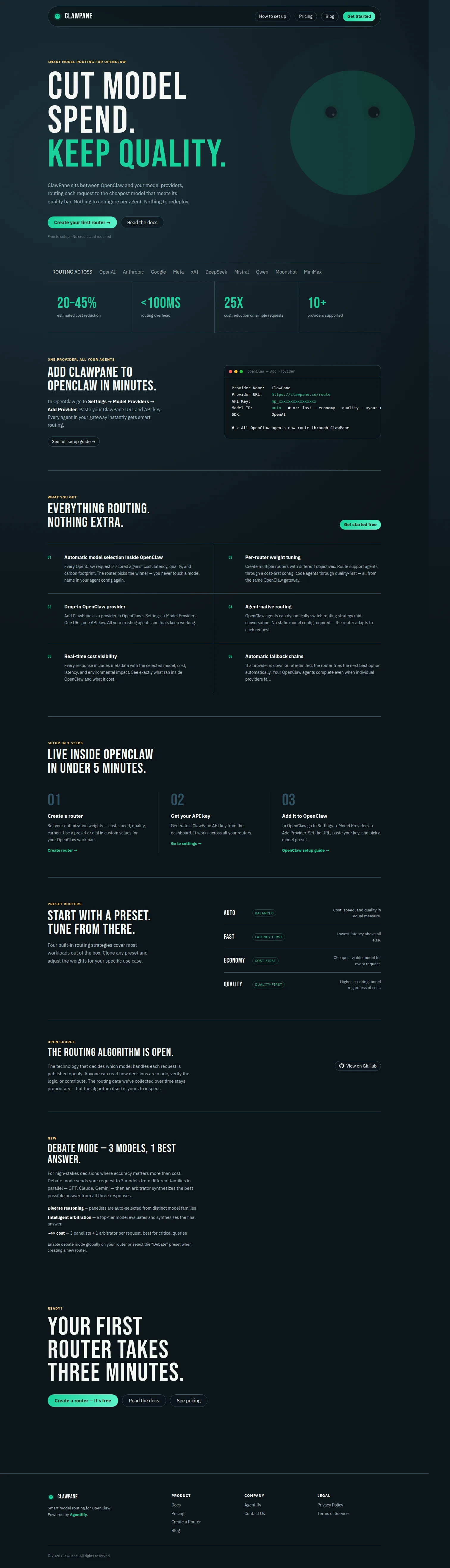
Cut model spend. Keep quality. — NOW THAT is how you write a headline! Two lines, zero fluff, instant tension and resolution. A developer scanning this page gets the pitch in under 3 seconds. I could KISS whoever wrote that. The subheadline — ClawPane sits between OpenClaw and your model providers, routing each request to the cheapest model that meets its quality bar — is technically precise and refreshingly honest. No buzzword soup. No leveraging synergies. Just WHAT IT DOES. Beautiful.
The CTA Create your first router → is action-oriented, above the fold, with Free to setup · No credit card required right underneath. That's the friction-reducer placed EXACTLY where it should be. Textbook.
Now here's where I start SHOUTING: WHERE IS YOUR SOCIAL PROOF?! Not a single number. Not a single team name. Not a single trusted by X developers. You've got 20–45% estimated cost reduction sitting in a metrics bar BELOW the fold, but nothing in the hero to back up your promise. And that word estimated? That's not confidence, that's HEDGING. That's a chef saying the fish is probably fresh. PROBABLY?! Either you have the data or you don't!
And that big circular visual on the right — what IS that? It's decorative at best. It tells me NOTHING about routing, nothing about cost savings, nothing about your product. A live routing visualization, a before/after cost chart, even a simple animated diagram showing requests flowing through ClawPane — ANY of those would do infinitely more work than a geometric shape sitting there looking pretty. Pretty doesn't convert. PROOF converts.
Improvement examples
Cut model spend. Keep quality.
Cut model spend. Keep quality. Trusted by 200+ OpenClaw teams saving an average of 38% on LLM costs.
Adding a specific social proof number directly in the hero kills the 'who actually uses this?' objection before it even forms. Even a small real number beats no number every single time.
20–45% estimated cost reduction
20–45% actual cost reduction (based on 1.2M routed requests)
'Estimated' sounds like a guess scribbled on a napkin. 'Based on X requests' sounds like data. Same range, completely different credibility signal.
Strengths
- 'Cut model spend. Keep quality.' is a tight, memorable headline that communicates the core value proposition in under 3 seconds — genuinely excellent copywriting
- CTA 'Create your first router →' uses an action verb, sits above the fold, with friction-reducing copy ('Free to setup · No credit card required') directly beneath it
- The subheadline is technically precise and jargon-free — it explains the mechanism honestly without resorting to marketing fluff
To improve
- ZERO social proof in the hero — no customer count, no company names, no testimonial snippet to build immediate credibility with skeptical developers
- The word 'estimated' in the metrics bar actively undermines confidence — if you have real data, OWN it
- The hero visual is a decorative shape that communicates nothing about routing or cost optimization — wasted prime real estate
Copywriting
DECENT
Sit down. Let's talk about your words.
The good news? Your copy is genuinely above average for a developer tool. You lead with outcomes, you avoid the worst enterprise buzzword sewage, and you've got lines that actually LAND. You never touch a model name in your agent config again — THAT is a benefit statement that makes a developer's heart sing. See exactly what ran inside OpenClaw and what it cost — concrete, tangible, no fluff. And Debate Mode — 3 models, 1 best answer is punchy enough to stick in someone's brain.
Your numbers are doing heavy lifting where they appear: 20–45%, <100ms, '25x', 10+ providers. Specific, credible, scannable. The pricing copy — Pay per token. No hidden multipliers — is BRILLIANT because it directly addresses the #1 anxiety of developers who've been burned by opaque AI pricing. You're not just stating a price, you're neutralizing a fear. Chef's kiss.
NOW. The bad news. Your copy speaks EXCLUSIVELY to someone who already uses OpenClaw and already understands LLM routing. Drop-in OpenClaw provider means NOTHING to anyone outside that ecosystem. Where's the copy for the CTO who's heard about LLM costs spiraling but doesn't know what routing is? Where's the entry point for someone who's on the fence about OpenClaw itself? You've built a restaurant that only serves regulars and then wonder why new customers don't walk in.
The six What You Get features? Presented as a flat grid of equal-weight items with no hierarchy. Automatic model selection and Real-time cost visibility are NOT equally important, but they LOOK identical. That's like putting your signature dish next to the bread basket and giving them the same plate. LEAD with your killers, then list the rest.
And the Open Source section — The routing algorithm is open — is being CRIMINALLY undersold. Publishing your decision logic is a MASSIVE trust signal in this space, and you've treated it like a footnote at the bottom of the menu.
Improvement examples
The routing algorithm is open. The technology that decides which model handles each request is published openly.
We publish exactly how routing decisions are made. Read the code, verify the logic, fork it if you want — nothing is hidden.
The original is passive and corporate, like a press release nobody asked for. The rewrite is direct, confident, and speaks to the developer instinct to verify before trusting.
Everything routing. Nothing extra.
Stop paying GPT-4 prices for GPT-3.5 tasks. ClawPane routes every request to the cheapest model that actually meets your quality bar.
The original is a catchy but EMPTY slogan — it could be about anything. The replacement gives the visitor a concrete mental image of the problem being solved and the money being wasted.
Strengths
- Specific, credible numbers throughout ('20–45%', '25x', '$0.50/1M tokens') that feel like real data from real usage, not marketing fairy dust
- Benefit-led statements like 'you never touch a model name in your agent config again' speak directly to developer pain points with surgical precision
- 'Pay per token. No hidden multipliers' directly neutralizes the #1 objection for cost-conscious developers — this is persuasion done right
To improve
- Heavy OpenClaw dependency in the copy — someone unfamiliar with OpenClaw has absolutely no entry point into the value proposition
- The six feature cards present everything with equal visual weight, burying your most compelling differentiators in a sea of sameness
- The Open Source section undersells a major trust signal — algorithm transparency is a BIG DEAL and it's treated like an afterthought
Call-to-Action
DECENT
Locked content
Social Proof
CRITICAL
Locked content
Architecture
DECENT
Locked content
SEO & Meta
DECENT
Locked content
Mobile
CRITICAL
Locked content
Visual Design & Branding
GOOD
Locked content
Performance
CRITICAL
Locked content
llmreadiness
CRITICAL
Locked content